Search Intent Matters More Than Ever
One of the best ways to respond to zero-click search is to understand search intent.
Search intent describes what the user actually wants to accomplish.
A keyword can be:
- Informational
- Navigational
- Commercial
- Transactional
For example:
“What is WordPress?”
is primarily informational.
“WordPress login”
is navigational.
“Best WordPress SEO plugins”
has commercial investigation intent.
“Buy WordPress hosting”
has transactional intent.
Zero-click results are often strongest when the answer is simple and immediate.
Commercial and transactional searches can still create strong opportunities because users often need additional information before making a decision.
This is why SEO strategies should not focus only on search volume.
The better question is: “What does the user need after searching this keyword?”
How to Optimize for Zero-Click Searches
The goal is not to fight search engines.
The goal is to make your website useful enough to appear in search features and valuable enough that users want to visit it.
1. Answer the Main Question Clearly
Give users a direct answer near the beginning of your article.
Don’t force readers through five paragraphs before explaining the basic concept.
For example:
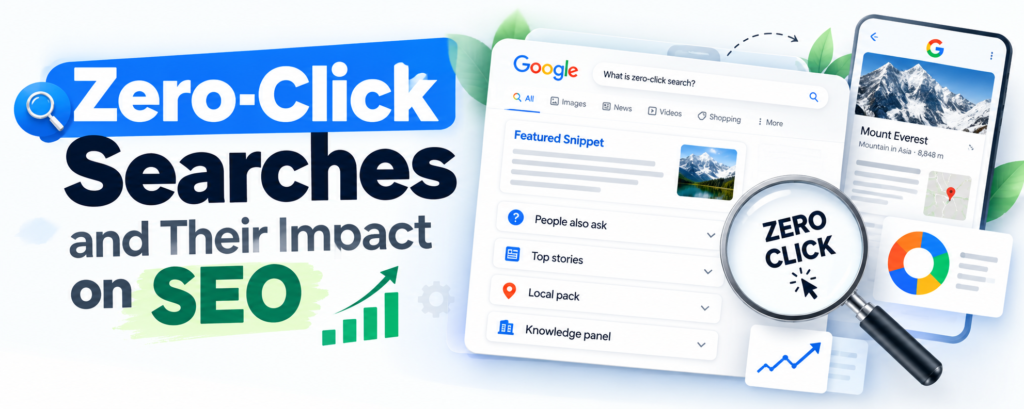
Zero-click searches are searches where users find the information they need directly on the search results page without clicking an organic result.
A clear answer can improve readability and make your content easier for search systems to understand.
2. Build Depth Around the Basic Answer
Don’t stop after answering the obvious question.
Expand the topic with:
- examples
- practical steps
- comparisons
- original insights
- case examples
- common mistakes
- FAQs
- expert perspectives
- useful visuals
The basic answer may satisfy a search engine feature.
The deeper content gives the reader a reason to visit your website.
3. Target Long-Tail Searches
Long-tail keywords often reveal more specific user needs.
Instead of targeting only:
“SEO”
you could target:
“How to improve SEO for a new WordPress website”
or:
“How to get organic traffic without backlinks”
These searches provide opportunities to create genuinely useful content rather than competing only for broad keywords.
4. Create Content That Cannot Be Easily Replaced
This is becoming one of the most important SEO principles.
If your article simply repeats information that can be found everywhere, a search engine can summarize the concept easily.
But original material is harder to replace.
Consider adding:
- original research
- screenshots
- experiments
- personal experience
- original comparisons
- unique examples
- expert interviews
- data analysis
- detailed tutorials
Google has increasingly emphasized original and useful content as its search experience evolves, including ways for users to find original sources and firsthand perspectives
5. Optimize for Brand Searches
One of the strongest long-term responses to zero-click search is building a recognizable brand.
Imagine two results:
“Best AI SEO tools”
and
“Best AI SEO Tools – Your Brand”
If users recognize your website, they are more likely to choose it.
Brand awareness can turn generic search visibility into repeat traffic.
That is why SEO should not operate separately from content marketing, social media, digital PR, and brand building.
Zero-Click Searches and AI Overviews
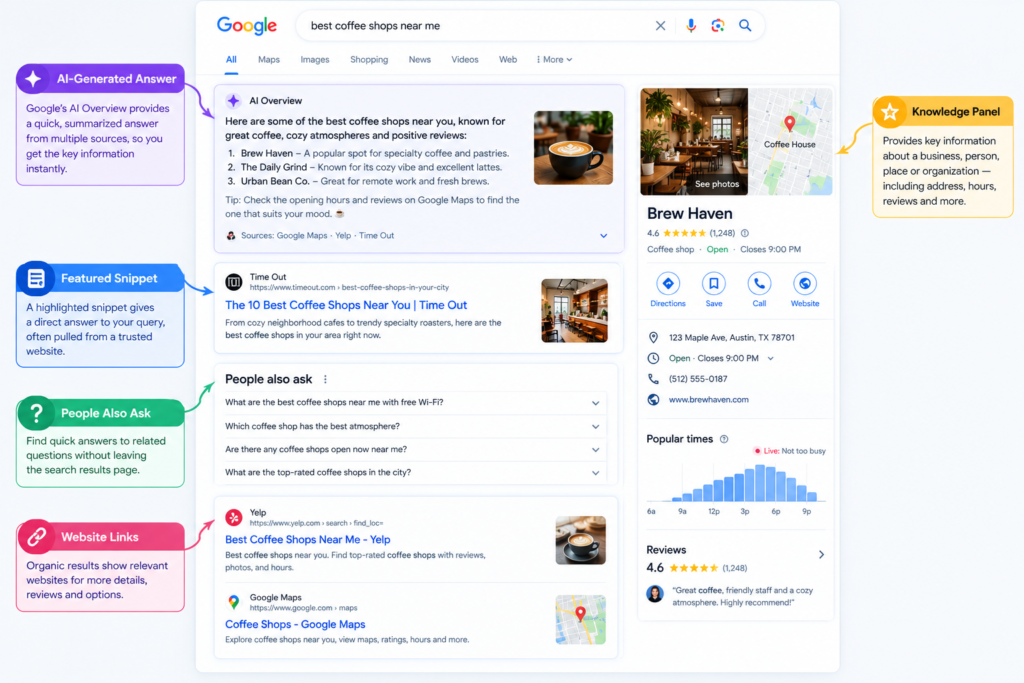
AI-powered search has made the topic even more important.
AI Overviews can provide summarized answers while also linking users to websites that support or expand on the information.
Google has said that its AI search experiences include prominent links and that it is continuing to experiment with ways to make those links more useful.
This creates a new SEO opportunity:
Don’t only optimize to rank. Optimize to become a source worth citing and visiting.
That requires strong topical relevance, trustworthy information, useful pages, and content that offers something beyond generic summaries.
Your previous article, “How to Get Your Brand Mentioned by AI Search Engines,” fits directly into this strategy.
Zero-click SEO and AI visibility are increasingly connected.
.
How to Measure SEO When Clicks Aren't Everything
If your website receives impressions but fewer clicks for some informational queries, don’t immediately assume the strategy has failed.
Look at a broader group of metrics.
Impressions: Are people seeing your website or brand in search?
Click-Through Rate: Which queries actually generate visits?
Rankings: Are your pages appearing for relevant keywords?
Branded Searches: Are more people searching specifically for your company or website?
Engagement: Once users arrive, do they actually read, interact, or explore?
Conversions: Do organic visitors subscribe, contact you, purchase something, or complete another important action?
The final metric is particularly important.
A keyword producing 10,000 impressions and almost no business value may be less useful than a keyword producing 500 impressions and several customers.
SEO should ultimately support a business objective—not simply produce large numbers in a dashboard.
What Website Owners Should Do Now
Zero-click searches are not a reason to abandon SEO.
They are a reason to make SEO smarter.
A modern content strategy should include several layers.
Layer 1: Visibility: Create content that can appear in traditional results and search features.
Layer 2: Authority: Publish trustworthy, useful, and original information.
Layer 3: Differentiation: Give readers something they cannot get from a generic summary.
Layer 4: Brand: Make your website recognizable and memorable.
Layer 5: Conversion: Give visitors a clear next step once they arrive.
- subscribing to an email list
- reading another article
- requesting a service
- buying a product
- downloading a resource
- contacting the business
The goal is to turn search visibility into a relationship rather than treating every search impression as a race for one click.
The Future of SEO in a Zero-Click World
Search will continue becoming more interactive.
Users may ask longer questions, search with images and voice, compare options directly in search, and use AI-generated responses before deciding which websites to visit.
Google has already described AI Search as a system designed to help users explore the web while providing links to relevant sources.
That means the future of SEO is unlikely to be simply:
“Get position #1.”
Instead, successful websites will need to become:
visible + useful + trustworthy + distinctive + worth visiting.
Some searches will never produce a click because the user genuinely doesn’t need one.
That’s okay.
The opportunity is to identify the searches where users do need more.
If your website provides the deeper explanation, original research, practical experience, comparison, product, or solution they are looking for, zero-click search does not eliminate your opportunity.
It changes where that opportunity begins.
Final Thoughts
Zero-click searches have changed the relationship between search engines and websites.
A user can now receive an answer without visiting a webpage, making simple informational keywords harder to monetize through organic traffic alone.
But that does not make SEO irrelevant.
It makes search intent, content quality, brand authority, and differentiation more important.
The smartest SEO strategy is not to fight every zero-click result. It is to understand why a search can be answered instantly—and then create content that gives users a reason to go further.
The future belongs to websites that do more than provide information.
They provide experience, evidence, originality, context, and solutions.
And when a search result cannot fully replace that value, the click still has a reason to happen.