SEO has changed significantly as artificial intelligence becomes part of both content workflows and the search experience itself. In 2026, SEO professionals are no longer using AI only to generate article ideas or rewrite paragraphs. Modern AI SEO tools can help with keyword research, content optimization, technical audits, competitor analysis, search visibility, and even tracking how brands appear in AI-generated answers.
But having more tools does not automatically mean having better SEO.
The challenge is choosing software that actually solves a problem in your workflow. Some platforms are designed as complete SEO suites, while others focus heavily on content optimization, AI-search visibility, technical SEO, or topic research.
This guide compares some of the best AI SEO tools in 2026, explains what each one is best at, and shows how to choose the right tool for your website, blog, agency, or business.
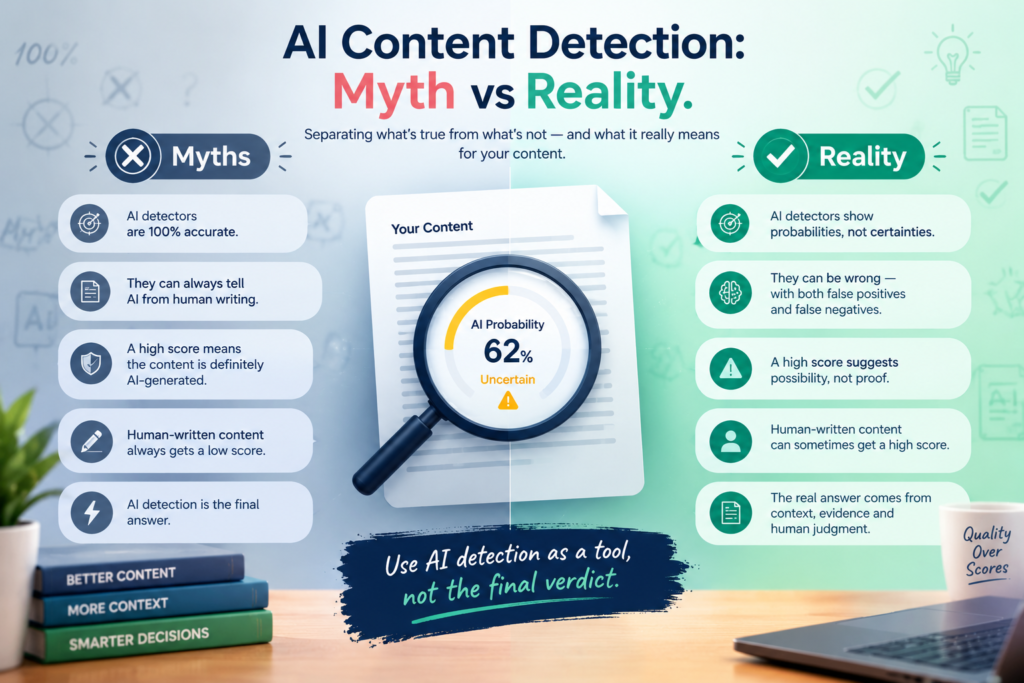
AI Content Detection: Myth vs Reality
Imagine spending three hours writing an article yourself.
- You research the topic.
- You rewrite sentences.
- You check your grammar.
- You make the introduction sound natural.
- Then you put your finished article into an AI detector.
- The result says:
- “82% AI-generated.”
- You know you wrote it yourself.
So what happened?
This situation captures one of the biggest misunderstandings surrounding AI content detection.
AI detectors can be useful tools, but an AI score is not a magical fingerprint that proves who wrote a piece of text.
Some detectors can identify patterns associated with AI-generated writing. But they can also produce false positives, miss AI-generated text, and behave differently depending on the text, language, editing, and detector being used.
Research continues to find important limitations in automated AI-text detection.
So let’s separate the myths from reality.
What Is AI Content Detection?
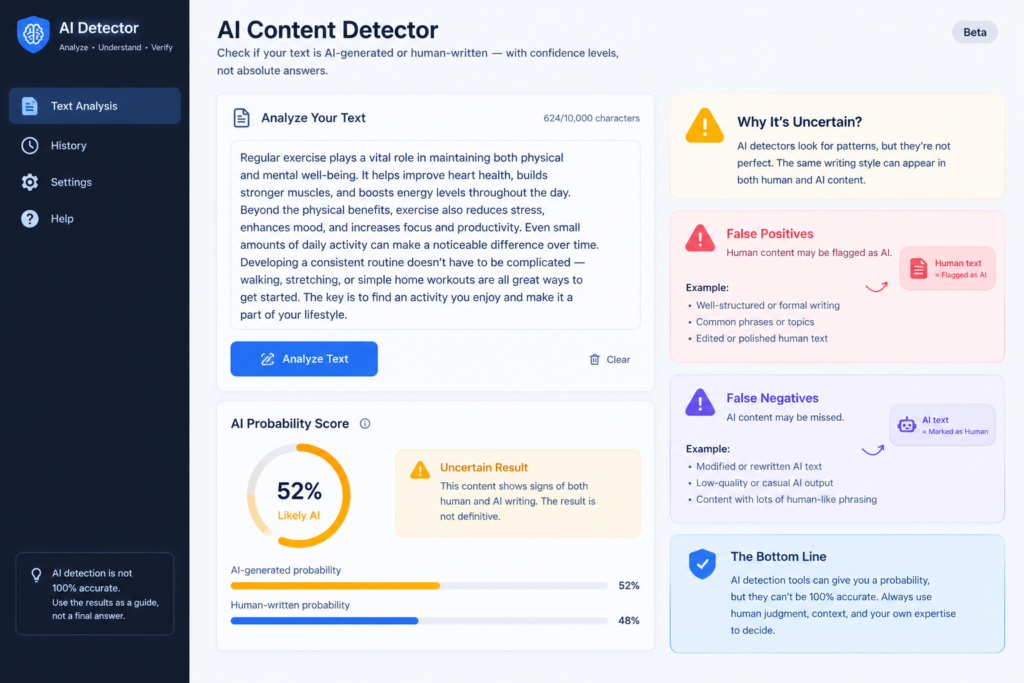
AI content detection refers to software designed to estimate whether a piece of text was generated by an artificial intelligence system.
These tools may analyze characteristics such as:
- Word patterns
- Sentence structure
- Predictability
- Vocabulary choices
- Writing style
- Statistical patterns
- Other linguistic signals
The detector then produces a result such as:
Likely human-written
or:
Likely AI-generated
Some tools also provide a percentage or confidence score.
But there is an important detail people often misunderstand:
A percentage is not the same thing as certainty.
If a detector says “90% AI,” that does not necessarily mean there is a scientifically established 90% probability that an AI system wrote the document.
The meaning of the score depends on the detector, its methodology, and how it was evaluated.
Myth #1: An AI Detector Can Always Tell Who Wrote the Text
Reality: No detector is perfect.
- This is probably the biggest myth.
- AI-generated text and human-written text can overlap in style.
- A human may naturally write predictable sentences.
- An AI model may produce highly natural sentences.
- A person may edit AI-generated text until it looks human.
- A person may also use grammar software that changes their writing style.
- All of these situations make detection more difficult.
Research evaluating AI detectors has found that performance can vary significantly depending on the text and conditions. Some studies have also documented false positives on human-written material.
So an AI detector should not automatically be treated as a judge that says:
“AI wrote this.”
A more accurate interpretation is:
“This detector found patterns that it associates with AI-generated writing.”
Those are very different statements.
Myth #2: An AI Score Is Proof
Reality: A detector score is an indicator, not definitive proof.
Imagine two people submit the same paragraph to different detection tools.
One says:
12% AI
Another says:
78% AI
Which one is correct?
This is exactly why detector results need context.
Different systems can use different methods, training data, thresholds, and assumptions.
A score can be useful as a signal for further investigation.
It should not automatically become the final verdict.
This distinction becomes especially important in education, employment, publishing, and other situations where a false accusation can have serious consequences.
Myth #3: Human Writing Always Gets a Low AI Score
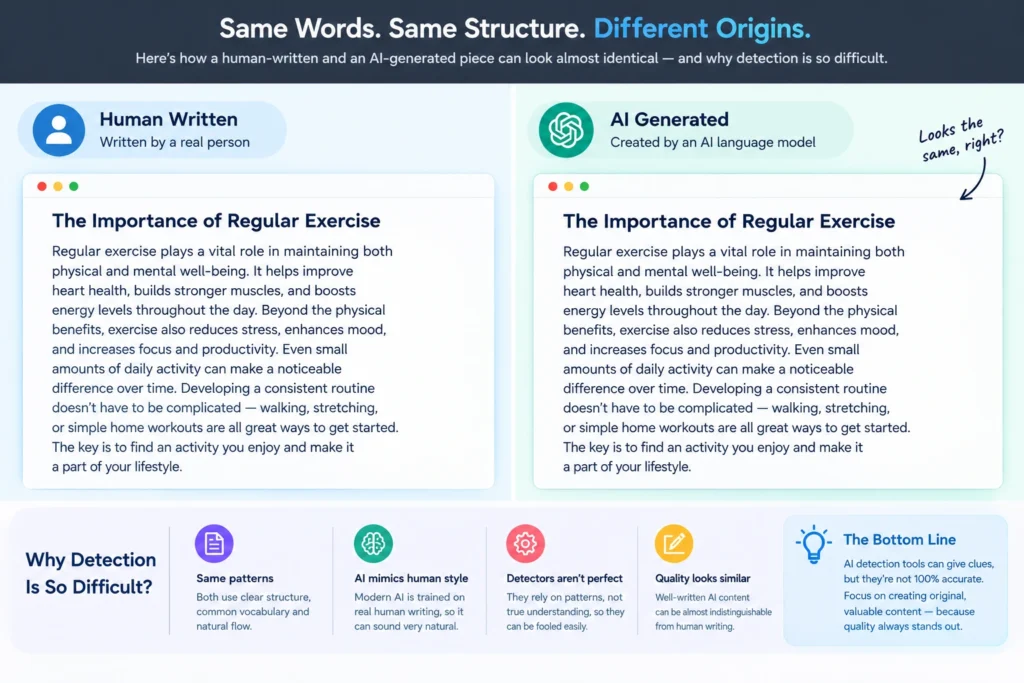
Reality: Human writing can sometimes trigger AI detectors.
This is one of the most uncomfortable problems with AI detection.
A person may write completely original content and still receive a high AI score.
Why?
Because detectors are looking for patterns—not reading your mind.
Writing that is highly structured, formal, predictable, polished, or repetitive may resemble patterns found in machine-generated text.
A 2026 study examining more than 135,000 document pairs found substantial variation in false-positive rates across 13 AI detectors, with results affected by editing style and other linguistic characteristics.
That doesn’t mean every detector is useless.
It means the result needs to be interpreted carefully.
Myth #4: AI Detectors Know Exactly Which AI Model Was Used
Reality: General AI detection and provenance are different things.
There is an important distinction between:
Detection
and
Provenance.
A detector may analyze text and estimate whether it resembles AI-generated writing.
Provenance systems can instead look for information about where content came from, such as metadata or embedded signals.
These are not the same technology.
For example, OpenAI currently describes provenance mechanisms for supported media that can include C2PA metadata and SynthID signals. Its public verification tool currently focuses on supported images and audio rather than acting as a universal detector for all AI-written text.
This distinction matters.
“This text looks AI-generated” is not the same as:
“We have reliable evidence that this exact AI system generated this text.”
Myth #5: AI Detection Is the Same as Plagiarism Detection
Reality: They answer different questions.
Plagiarism detection generally looks for similarities between submitted material and existing sources.
- AI detection attempts to estimate whether text resembles AI-generated writing.
- Those are fundamentally different tasks.
- For example, someone could write an original article entirely with AI.
- It might contain no copied passages from existing websites.
- A plagiarism checker might find little or no matching material.
- An AI detector might still flag it.
- On the other hand, a human could copy an existing article word-for-word.
- A plagiarism checker could identify the similarity even though no AI was involved.
So:
Plagiarism detection ≠ AI detection.
Myth #6: Editing AI Text Always Makes It Undetectable
Reality: Editing can change detector results, but there is no universal formula.
You may have heard advice like:
“Just rewrite the AI content and every detector will say human.”
That’s an oversimplification.
Editing can affect detection results, but different detectors respond differently.
Research has demonstrated that relatively modest changes to generated text can significantly affect some detection systems.
This creates a constant technological race:
Generation improves → detection improves → editing changes the signal → detection adapts.
That’s one reason AI text detection remains a difficult technical problem.
Myth #7: Short Text Is Easy to Detect
Reality: Short text can actually be difficult to classify reliably.
Consider this sentence:
“The meeting starts at 10 a.m.”
Did AI write it?
Did a human write it?
There may be no meaningful way to know from that sentence alone.
Very short passages contain less information for a detector to analyze.
OpenAI’s earlier public AI text classifier specifically noted that it was unreliable on short text, among other limitations, and OpenAI discontinued that classifier in 2023 because of its low accuracy.
This is an important historical lesson:
Even the creators of AI systems have recognized how difficult reliable text detection can be.
Myth #8: If an AI Detector Says 100% AI, It's Definitely AI
Reality: A high score still needs context.
A very high score can certainly be a reason to investigate.
But it shouldn’t automatically be treated as conclusive evidence.
Why?
Because the detector could be responding to writing characteristics rather than knowing the actual origin of the text.
Consider a formal academic paragraph.
It may contain:
- Consistent grammar
- Predictable vocabulary
- Structured sentences
- Few spelling mistakes
- Repeated terminology
Those characteristics aren’t exclusive to AI.
A careful human writer can produce them too.
The important question is not:
“What number did the detector produce?”
It is:
“What evidence supports the conclusion?”
Myth #9: AI Detectors Are Useless
Reality: They can still be useful when used appropriately.
It’s easy to swing from one extreme to another.
First, someone says:
“AI detectors are 100% accurate.”
That’s wrong.
Then someone responds:
“AI detectors are completely useless.”
That’s also too simplistic.
Detection systems can provide useful signals.
For example, they may help an organization decide that a piece of content deserves additional review.
The problem begins when the detector’s output is treated as unquestionable evidence.
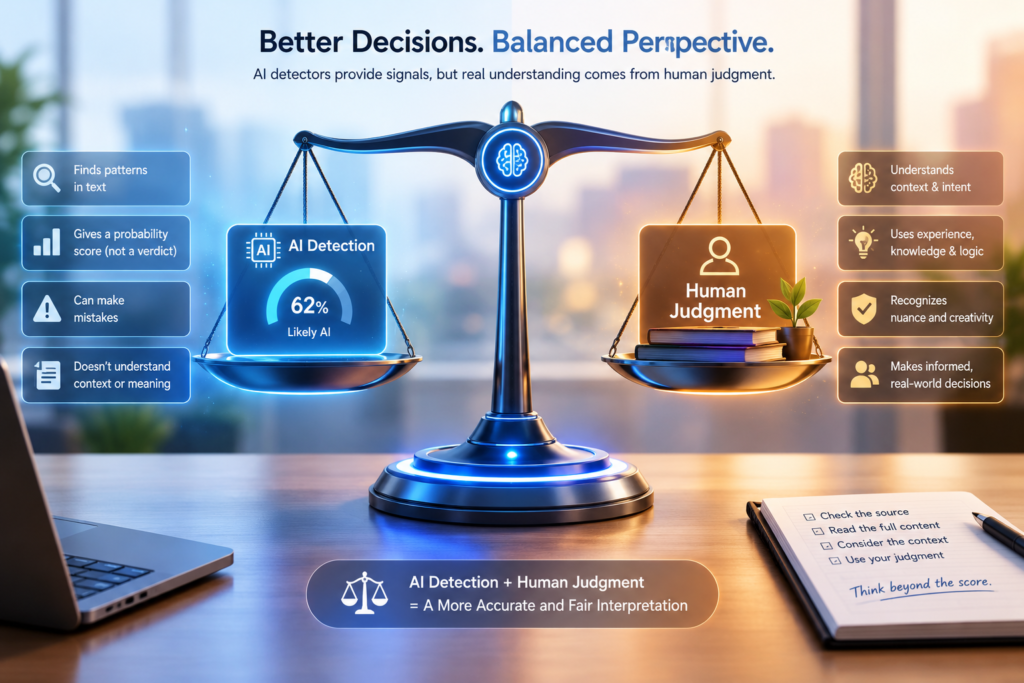
A better approach is:
Detector result + context + human review + supporting evidence.
That is much more reasonable than:
Detector result = guilt.
Why Is AI Detection So Difficult?
This is where the technology gets fascinating.
AI models generate text by producing likely sequences of language.
Human writing also contains patterns.
That’s the fundamental problem.
There isn’t a giant invisible label attached to every sentence saying:
“Written by human.”
- Text is simply text.
- Now add another complication.
- Humans edit.
- AI generates.
- Humans edit AI.
- AI can generate different styles.
- People can deliberately imitate different writing styles.
- Grammar tools can rewrite sentences.
- Translation tools can transform language.
- All of this creates overlapping patterns.
- The boundary becomes blurry.
The False-Positive Problem
A false positive occurs when a detector identifies human-written text as AI-generated.
This is particularly important.
Imagine a student writes an essay independently.
A detector flags it.
The student is then accused of using AI.
If the detector is wrong, the technology has caused a serious problem.
Studies have documented false positives and differences in detector performance across writing conditions.
This is why a detector score should generally be treated as one piece of information, not a final judgment.
The False-Negative Problem
The opposite problem is also possible.
A false negative occurs when AI-generated text is classified as human-written.
This means a detector can fail in both directions:
Human → flagged as AI
and:
AI → classified as human
That makes absolute claims about detection particularly risky.
A system can be useful without being perfect—but users need to understand its limitations.
Does AI Detection Work Better in English?
Performance can vary by language.
Some detectors are designed primarily for English, while others claim support for multiple languages.
However, language, writing style, domain, and the detector itself can all affect results.
OpenAI’s discontinued text classifier explicitly warned that it performed worse outside English.
Research has also examined problems involving non-native English writing and found that linguistic style can influence detector results.
This creates an important fairness concern.
A detector shouldn’t be treated as equally reliable across every language, writer, and writing environment without evidence demonstrating that reliability.
What About Students?
This is one of the most controversial uses of AI detection.
Teachers and universities need ways to protect academic integrity.
At the same time, students deserve a fair evaluation process.
A detector score alone may not tell the full story.
A better approach can include:
- Draft history
- Notes and outlines
- Previous writing samples
- Citations
- Oral discussion
- Revision history
- Assignment context
- Human evaluation
For example, if a student claims they wrote an essay themselves, reviewing their drafts and asking them to explain their argument can provide information that a detector score cannot.
The goal should be understanding authorship, not simply generating a percentage.
What About Bloggers and SEO Writers?
This is where the conversation gets interesting for website owners.
Many publishers worry:
“If I use AI to help write content, will search engines punish my website?”
The better question is:
“Is the content genuinely useful?”
AI can be used for brainstorming, outlining, editing, research organization, and many other tasks.
But publishing large amounts of generic, low-value material simply because it can be produced quickly is a different strategy.
For bloggers, the strongest approach is to add things AI-generated generic content often lacks:
- Original research
- First-hand experience
- Real examples
- Expert commentary
- Unique data
- Useful screenshots
- Personal testing
- Strong opinions backed by evidence
The goal shouldn’t be:
“How do I make AI content look human?”
The better goal is:
“How do I make my content genuinely valuable?”
Can AI Detectors Be Beaten?
There is no single universal answer.
Research has shown that AI-generated text can sometimes evade detection after changes or under different testing conditions.
- But trying to “beat the detector” is the wrong long-term strategy.
- Detection systems change.
- Models change.
- Writing changes.
- Evaluation methods change.
Instead of playing an endless game of:
AI → detector → humanizer → detector → rewrite
focus on producing authentic, high-quality work.
If you’re using AI as an assistant, maintain your own research, reasoning, drafts, and edits.
That gives you something much more valuable than a low detector score:
evidence of genuine work.
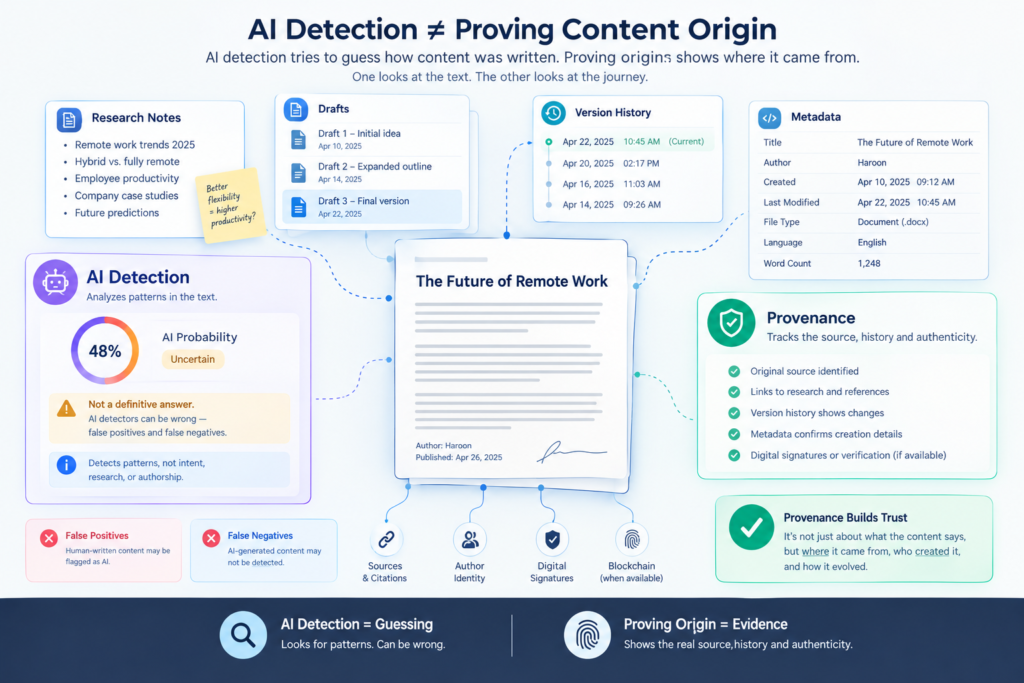
The Better Way to Prove Human Work
If authorship matters, don’t rely entirely on detection.
Keep evidence of your process.
For writers, that could include:
- Research notes
- First drafts
- Outlines
- Version history
- Source lists
- Revision history
- Project files
- Personal notes
For students, document how the assignment developed.
For professional writers, use version-controlled documents where possible.
For businesses, maintain editorial workflows.
This approach focuses on provenance and process, rather than trying to guess authorship from the final text alone.
AI Detection vs AI Provenance
These concepts deserve their own distinction.
AI Detection
Attempts to answer:
“Does this content look like it was generated by AI?”
AI Provenance
Attempts to answer:
“Can we establish information about where this content came from?”
Provenance can involve metadata, credentials, watermarks, or other technical signals.
For supported OpenAI-generated images and audio, OpenAI currently uses provenance signals including C2PA and SynthID, while noting that the absence of a detected signal does not prove that content was not generated by OpenAI tools.
That illustrates an important principle:
Knowing where content came from can be more informative than guessing based only on its writing style.
What Should You Do If a Detector Flags Your Writing?
Don’t panic.
First, check the actual content.
Ask:
- Did I write this?
- Do I have drafts?
- Can I explain the ideas?
- Do I have my research sources?
- Did I use an AI tool during the process?
- What does the detector actually claim?
- Was the text long enough for the tool to evaluate meaningfully?
- Is the result consistent across multiple checks?
If you wrote the content yourself, your drafts and writing process can be much stronger evidence than a single detector score.
If you used AI assistance, follow the rules that apply to your school, employer, client, or publication.
Transparency is usually better than trying to hide the process.
The Biggest Myth of All
The biggest myth is that there is a simple technological battle between:
Human writing vs AI writing.
- Reality is much messier.
- A human can use AI.
- AI can be edited by a human.
- A human can write in a style that resembles AI.
- AI can imitate human styles.
- A document can contain both human and AI contributions.
That’s why the question:
“Was this written by AI?”
can sometimes be less useful than:
“How was this content created, and can the author demonstrate that process?”
That is a much harder question—but also a much more meaningful one.
The Future of AI Content Detection
AI detection will probably continue evolving.
Models are becoming more capable.
Detection methods are also improving.
At the same time, writing workflows are changing.
AI assistance is becoming integrated into editing, research, translation, coding, marketing, education, and creative work.
This means the future may focus less on a simple AI-versus-human label and more on content provenance, transparency, and responsible use.
In other words, the future may not ask:
“Can a machine guess who wrote this?”
It may increasingly ask:
“Can we understand how this content was created?”
That’s a much more useful direction.
Final Verdict: Myth vs Reality
So, can AI content detectors identify AI writing?
Sometimes.
Are they always accurate?
No.
Can human writing be incorrectly flagged?
Yes.
Can AI-generated writing escape detection?
Yes.
Does a detector percentage prove authorship?
No.
Can detection tools still be useful?
Yes—when treated as signals rather than unquestionable proof.
The technology is useful, but the marketing around it can sometimes make it sound more certain than it really is.
The smartest approach is to combine technology with context, human judgment, and evidence of the content-creation process.
And for writers, students, businesses, and bloggers, there’s an even simpler lesson:
Don’t build your strategy around fooling an AI detector. Build your work around being genuinely good.
Because a detector score can change.
A piece of valuable work remains valuable.
Key Takeaways
- AI content detectors estimate whether text resembles AI-generated writing.
- They are not universal proof of authorship.
- False positives and false negatives are real concerns.
- Different detectors can produce different results.
- Writing style, language, editing, and text length can affect detection.
- AI detection is different from plagiarism detection.
- AI detection is also different from content provenance.
- Human review and context are important when authorship matters.
- Writers should keep drafts, notes, research, and revision history when useful.
- Bloggers should focus on original, useful, trustworthy content rather than trying to manipulate detector scores.
- AI-assisted content and low-quality content are not automatically the same thing.
- The future of content verification may increasingly involve provenance and transparency alongside detection.
Frequently Asked Questions (FAQs)
They can sometimes identify text that resembles AI-generated writing, but they cannot guarantee that a particular passage was written by ChatGPT. Different detectors can produce different results, and detection can be affected by editing and other factors.
They can provide a signal for further review, but they should not automatically be treated as conclusive evidence of academic misconduct. Context and other evidence are important.
AI SEO tools cannot guarantee higher rankings. They can help identify keywords, search intent, technical issues, content gaps, and optimization opportunities. Actual search performance depends on many factors, including content quality, relevance, competition, website health, authority, and how well the page satisfies users.
No. Plagiarism detection generally looks for similarities with existing sources, while AI detection attempts to estimate whether text resembles machine-generated writing.
useful for learning, but serious SEO work may require paid features.
Bloggers should focus more on producing accurate, useful, original content than on achieving a particular AI-detector score. If AI tools are used, the appropriate approach depends on the publication’s or platform’s rules.
Keep evidence of your writing process, such as outlines, notes, drafts, research sources, document version history, and revisions. These can provide useful context that a detector score cannot.
Conclusion
In conclusion, AI content detection is a useful but imperfect technology that helps identify patterns commonly associated with AI-generated writing. However, AI detectors are not always accurate and can sometimes misidentify human-written content as AI-generated or fail to recognize AI-assisted text. This means their results should not be treated as absolute proof of how a piece of content was created.
As AI writing tools continue to evolve, understanding the difference between myths and reality becomes increasingly important for writers, bloggers, students, and businesses. Instead of relying entirely on detection scores, focus on creating original, valuable, well-researched content that reflects human judgment, expertise, and creativity. Ultimately, quality content matters more than simply trying to pass an AI detector.