Imagine someone asks an AI search engine:
“What are the best brands for this product?”
Your competitor appears in the answer.
Your brand doesn’t.
You may have a good website, publish regularly, and even rank well on Google—but the AI doesn’t mention you.
This is becoming an important digital marketing problem.
As AI-powered search experiences become more common, brands are no longer competing only for traditional search rankings. They are also competing to become sources, recommendations, and recognizable entities in AI-generated answers.
So how can you increase the chances of your brand being discovered and mentioned?
There is no secret button that puts a company into AI answers. AI systems use different technologies, data sources, search indexes, and retrieval methods, and their behavior can change.
However, there are practical things businesses can do to make their brand more discoverable, understandable, credible, and consistently represented across the web.
Let’s look at them.
What Does It Mean for an AI Search Engine to Mention Your Brand?
Traditional search usually gives you a list of webpages.
AI search can work differently.
A user might ask:
“What are the best project management tools for a small business?”
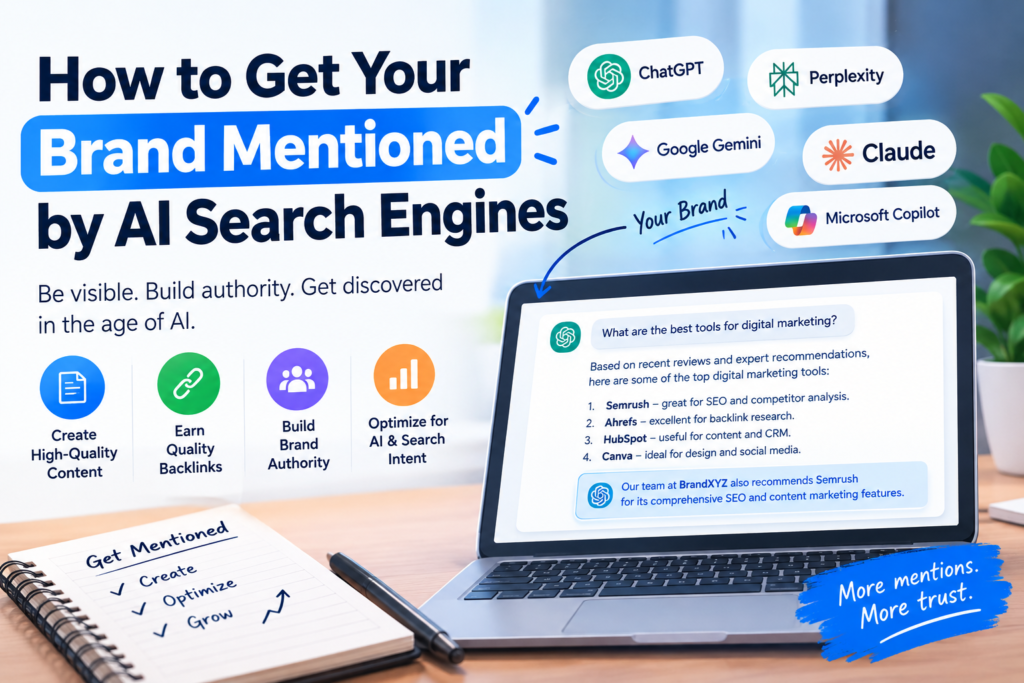
Instead of showing only ten blue links, an AI-powered search experience may provide a written response and reference several companies, products, or websites.
If your company is included, that’s a brand mention.
The mention could potentially appear alongside:
- Your company name
- Your website
- A product
- A service
- A recommendation
- A citation or source
- A comparison
- A description of what your company does
The important point is that AI visibility is not exactly the same thing as ranking #1 in Google.
A brand can be visible in different ways across the search ecosystem.
Why AI Brand Mentions Matter
People increasingly use AI tools to research products, services, software, businesses, and solutions.
A recommendation from an AI system can introduce a brand to someone who had never heard of it before.
This creates a new opportunity for businesses.
But there is an important distinction:
You cannot simply tell an AI system to recommend your brand.
You need to build the signals that make your company easier to discover and understand.
Think of it this way.
If your brand exists only on your own website, an AI system has relatively little independent information about how other people describe your company.
If your brand has a strong website, useful content, reputable mentions, reviews, industry coverage, profiles, and consistent information across multiple sources, your digital footprint becomes much stronger.
1. Make Your Brand Easy to Understand
Before worrying about AI visibility, make sure a human can understand your company in seconds.
Your homepage should clearly answer:
Who are you?
What do you sell?
Who is it for?
What makes you different?
For example, instead of writing:
“We empower businesses through innovative digital experiences.”
Say:
“We create websites and SEO strategies for small businesses.”
The second statement gives search systems and users much clearer information.
Your important pages should clearly describe:
- Products
- Services
- Industry
- Location, if relevant
- Target customers
- Expertise
- Company information
- Clarity is the foundation of discoverability.
2. Build a Strong About Page
Your About page is more important than many businesses realize.
It should explain:
- Who founded the company
- What the company does
- When it was established, where relevant
- What expertise it has
- Who it serves
- What makes it different
- Relevant qualifications or experience
Don’t turn it into a corporate essay.
Make it factual.
A strong About page helps create a consistent identity around your brand.
3. Create Original Content Around Your Expertise
If you want your brand associated with a particular subject, talk about that subject.
Suppose you own a cybersecurity company.
Don’t publish random articles about general business news.
Build useful content around:
- Cybersecurity for small businesses
- Password security
- Phishing prevention
- Website security
- Data protection
- Security audits
- Common cybersecurity mistakes
Over time, this creates a clear relationship between your brand and your area of expertise.
This is often described as topical authority.
The goal isn’t to mention your company name in every paragraph.
The goal is to become genuinely useful within your category.
4. Answer Questions People Actually Ask
AI search is built around questions.
That makes question-focused content particularly useful.
Create pages that answer questions such as:
- What is the best solution for…?
- How does [product/service] work?
- How much does… cost?
- What should businesses consider before buying…?
- What is the difference between X and Y?
- Is X suitable for beginners?
- What are the advantages and disadvantages of…?
Don’t manufacture questions just to insert keywords.
Find real problems your customers have and answer them thoroughly.
A useful answer can also become an entry point to your brand.
5. Earn Mentions From Other Websites
One of the strongest ways to build online authority is to have other reputable websites talk about your brand.
This is where digital PR becomes valuable.
You could earn coverage through:
- Industry publications
- News websites
- Expert interviews
- Podcasts
- Original research
- Data studies
- Guest contributions
- Business directories
- Industry associations
- Product reviews
The goal isn’t to collect hundreds of meaningless links.
A single relevant mention from a respected publication can be more meaningful than dozens of low-quality directory listings.
Think relevance and credibility, not quantity.
6. Publish Original Research
Here’s one of the most powerful ways to make your brand worth mentioning:
Create information that didn’t exist before.
For example, a marketing company could survey 500 small businesses about their advertising challenges.
A software company could publish research about productivity trends.
A cybersecurity company could analyze common security problems affecting websites.
Then other websites have a reason to reference the research.
You aren’t simply saying:
“We are experts.”
You’re producing evidence that people can discuss.
That’s a much stronger position.
7. Build Consistent Brand Information
Imagine your website says your company specializes in SEO.
Your LinkedIn profile says you’re a web-development company.
A business directory describes you as a marketing agency.
A review platform uses a completely different company description.
This creates unnecessary confusion.
Try to keep important information consistent across legitimate platforms:
- Brand name
- Website
- Company description
- Product names
- Service categories
- Founder information
- Business location
- Contact information
Consistency helps people—and potentially search systems—understand that these references belong to the same organization.
8. Don't Ignore Reviews
Reviews can be powerful because they provide independent customer experiences.
Depending on your industry, consider maintaining legitimate profiles on relevant review platforms and business directories.
Encourage genuine customers to leave honest feedback.
Don’t buy fake reviews.
Don’t create fake customer accounts.
Don’t write reviews for yourself.
Those shortcuts can damage trust and create long-term problems.
Real customer experiences are much more valuable.
9. Strengthen Your Digital PR Strategy
Traditional SEO often focuses heavily on ranking pages.
AI visibility makes brand reputation increasingly interesting.
Digital PR can help you get your company into conversations outside your own website.
For example, a founder might:
- Comment on industry trends
- Provide expert opinions to journalists
- Appear on podcasts
- Participate in interviews
- Publish original research
- Speak at industry events
- Contribute expert commentary
When credible sources repeatedly discuss your company in relevant contexts, your brand becomes more visible across the wider web.
10. Create Comparison and Alternative Content Carefully
People frequently ask questions like:
“Which tool is better, X or Y?”
Or:
“What are the alternatives to X?”
If you sell software, products, or services, comparison content can be extremely useful.
For example:
“Our Product vs. Traditional Solution”
or
“Best Alternatives for Small Businesses”
But don’t turn every comparison into a biased advertisement.
Be honest about:
- Strengths
- Weaknesses
- Pricing
- Features
- Best use cases
- Who should choose each option
Trustworthy comparison content is more useful than a page that simply declares your product the winner.
11. Make Your Website Technically Strong
Great branding cannot compensate for a website that search engines struggle to access.
Make sure your website has:
- Crawlable pages
- Logical navigation
- Descriptive titles
- Useful headings
- Internal links
- Mobile-friendly design
- Fast, usable pages
- HTTPS
- Accurate metadata
- Appropriate structured data where relevant
Technical SEO doesn’t guarantee AI mentions.
But it helps make your information easier for search systems to discover and interpret.
12. Use Structured Data Where It Makes Sense
Structured data gives search engines additional machine-readable information about webpages and entities.
Depending on your website, relevant structured data can include information about:
- Organization
- Products
- Articles
- Events
- Local businesses
- FAQs, where supported and appropriate
Structured data isn’t a magic AI-ranking trick.
Think of it as clear labeling, not a shortcut.
Your underlying page content still needs to be accurate and useful.
13. Build a Real Brand, Not Just a Keyword Website
There is no universal winner.
For an all-in-one SEO platform, Semrush is a strong choice.
For SEO research and competitor analysis, Ahrefs is an excellent option.
For content optimization, Surfer is particularly focused on the workflow.
For AI-assisted SEO content, Frase is worth considering.
For content teams, Clearscope offers a strong content-focused workflow.
For SEO plus AI visibility tracking, SE Ranking is a compelling option.
For content strategy and topic planning, MarketMuse stands out.
The best choice depends on what you actually need rather than which platform has the longest feature list.
14. Create Content That Other People Want to Reference
Here’s a simple test for your next article:
Would another website have a reason to mention this?
If the answer is no, consider improving it.
Instead of another generic article like:
“10 Tips for Better SEO”
create something more distinctive:
“We Analyzed 100 Small-Business Websites: Here Are the Five SEO Problems We Found Most Often”
The second idea has a stronger reason to be discussed.
Originality creates opportunities for mentions.
15. Don't Try to Manipulate AI Answers
As AI search becomes more important, some people will inevitably try to manipulate it.
They may attempt to:
- Generate thousands of fake pages
- Create fake reviews
- Publish artificial mentions
- Spam forums
- Stuff brand names into content
- Build low-quality links
- Create misleading comparisons
Don’t build your strategy around tricks.
AI systems and search engines continuously change.
A tactic that appears to work temporarily can become useless—or harmful.
A stronger strategy is:
Make your brand genuinely useful, credible, and easy to understand.
What About ChatGPT, Google, and Other AI Search Systems?
Different AI products can use different methods to generate answers.
Some may rely on web search, some on indexed information, some on proprietary datasets, and some on combinations of sources.
Their systems can also change over time.
Therefore, don’t assume there is one universal formula called “AI SEO.”
Instead, focus on principles that make sense across the web:
Be discoverable.
Be understandable.
Be useful.
Be credible.
Be consistently represented.
Earn independent recognition.
Those principles are much more durable than trying to reverse-engineer one AI system.
A Simple AI Brand Visibility Roadmap
If you’re starting from zero, don’t try everything at once.
Step 1: Clarify Your Brand
Define exactly what you do, who you serve, and what category you belong to.
Step 2: Improve Your Website
Create strong Home, About, Product/Service, Contact, and relevant content pages.
Step 3: Build Topical Content
Publish genuinely useful articles around your core expertise.
Step 4: Create Something Original
Develop research, data, tools, case studies, experiments, or unique insights.
Step 5: Earn Relevant Mentions
Use digital PR, partnerships, interviews, podcasts, and industry publications.
Step 6: Strengthen Reputation
Collect genuine customer reviews and maintain accurate business profiles.
Step 7: Monitor AI Visibility
Periodically test relevant questions across major AI-powered search experiences.
Don’t obsess over whether your brand appears every time.
Look for patterns.
Are competitors being mentioned for questions where your brand should reasonably be considered?
If so, investigate why.
What You Should NOT Do
Avoid these shortcuts:
- Buying fake reviews
- Creating fake brand mentions
- Spamming online communities
- Publishing thousands of low-value AI articles
- Keyword stuffing
- Creating misleading comparisons
- Buying irrelevant backlinks
- Making unsupported claims about your expertise
AI visibility should be treated as a long-term reputation strategy, not a hack.
The Future of Brand Discovery
Search is moving beyond a simple relationship between a keyword and a webpage.
People increasingly discover businesses through a mixture of:
- Search engines
- AI assistants
- Social media
- Videos
- Reviews
- Communities
- News websites
- Podcasts
- Recommendations
- Direct brand searches
That means your brand’s online presence matters more than any single webpage.
A business that is mentioned, reviewed, discussed, cited, and consistently described across reputable sources has a much stronger digital footprint than a business that exists only on its own homepage.
Key Takeaways
- AI search is creating new opportunities for brand discovery.
- There is no guaranteed formula for getting mentioned by every AI search engine.
- Clear brand information makes your business easier to understand.
- Original content can help differentiate your brand.
- Independent mentions and digital PR can strengthen visibility.
- Genuine reviews can contribute to online reputation.
- Consistent company information matters.
- Technical SEO still provides an important foundation.
- Structured data can help communicate information in machine-readable formats where appropriate.
- Original research gives other websites a reason to reference your brand.
- Avoid fake reviews, spam, and attempts to manipulate AI systems.
- Think beyond rankings and focus on becoming a trusted name in your category.
Conclusion
Getting your brand mentioned by AI search engines isn’t about finding a secret prompt or manipulating an algorithm.
It’s about becoming the kind of brand that deserves to be discovered.
Build a website that clearly explains what you do.
Create content that genuinely helps people.
Publish information that others don’t already have.
Earn legitimate coverage.
Collect real customer experiences.
Build relationships in your industry.
And make sure your brand is represented consistently across the web.
AI search may change how people discover businesses, but one principle is unlikely to disappear:
Trust is difficult to manufacture and easy to recognize when it is real.
The brands that invest in expertise, originality, reputation, and usefulness today will be better positioned for whatever search looks like tomorrow.
The goal isn’t simply to get an AI to say your name.
The goal is to become a brand that people—and the systems helping them discover information—have a reason to remember.
Frequently Asked Questions (FAQs)
There is no single best tool for everyone. Semrush is a strong all-around choice, while Ahrefs is particularly useful for research, Surfer for content optimization, Frase for AI-assisted content, and MarketMuse for content strategy. The best option depends on your website, budget, workflow, and SEO goals.
They can be valuable when they solve a specific SEO problem. AI SEO tools can reduce manual research, identify content opportunities, analyze competitors, and help optimize pages. However, they should support human judgment rather than replace it. The value comes from using the right tool for the right workflow.
AI SEO tools cannot guarantee higher rankings. They can help identify keywords, search intent, technical issues, content gaps, and optimization opportunities. Actual search performance depends on many factors, including content quality, relevance, competition, website health, authority, and how well the page satisfies users.
There is no single free tool that provides everything. Some major SEO platforms offer limited free access or free tools. For example, Ahrefs currently provides a free account with limited access to selected tools for verified websites. Free versions are useful for learning, but serious SEO work may require paid features.
No. AI tools can automate or accelerate many SEO tasks, but they do not replace strategic thinking, business understanding, editorial judgment, technical decision-making, or human quality control. The strongest approach is usually to combine AI-assisted tools with human expertise.
Conclusion
The best AI SEO tools in 2026 are not necessarily the ones that generate the most content. The most useful tools are those that help you make better decisions, save time, identify opportunities, and understand how your website performs across traditional and AI-powered search.
If you are a beginner, start with one platform that matches your primary goal. A blogger may benefit more from a content optimization tool, while an agency may need a broader SEO and AI-visibility platform.
Most importantly, do not let the AI label distract you from the fundamentals of SEO. Research your audience, understand search intent, create genuinely useful content, maintain a technically healthy website, and use AI to make that process more efficient.
AI can accelerate SEO work, but good strategy still comes first.