GEO (Generative Engine Optimization) for Beginners: A Complete Guide
 Abou Bakar9 November 202614 min read
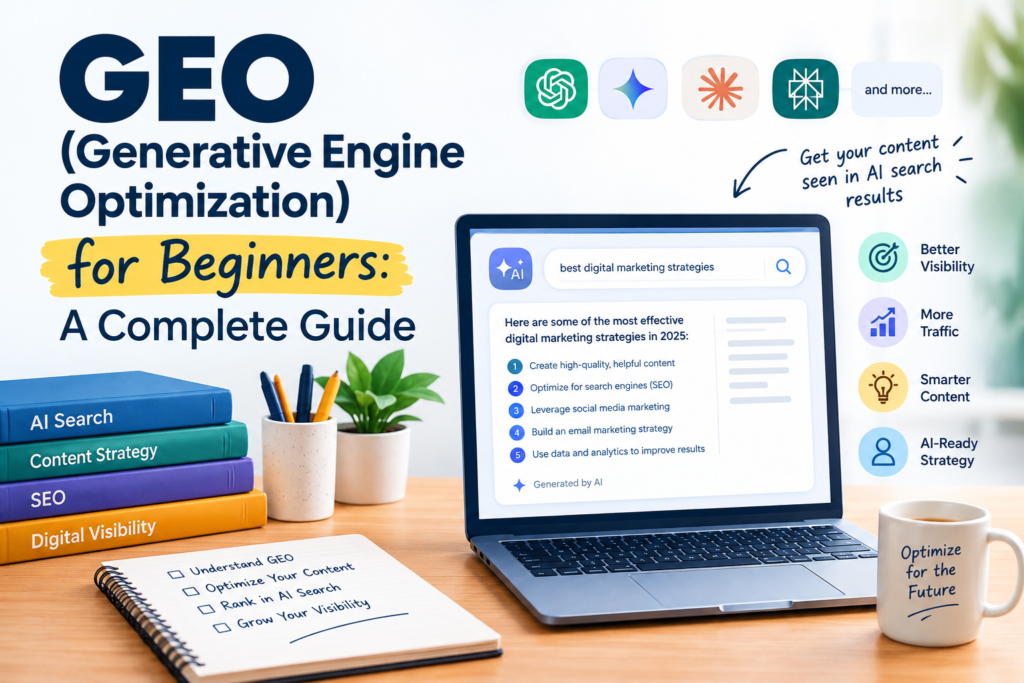
Search is changing. People no longer rely only on traditional search engines to find information. They also ask AI-powered tools to explain concepts, compare products, recommend services, and summarize complicated topics. Instead of browsing several websites, users may receive a single answer that brings information together from multiple sources.
This change introduces a growing area of digital marketing called GEO (Generative Engine Optimization). For beginners, understanding GEO is an opportunity to learn how content can become more useful and discoverable in AI-generated answers.
Whether you run a WordPress blog, manage a business website, or are learning SEO in Pakistan, this guide will explain what GEO means, how it differs from traditional SEO, and what you can do to prepare your content for AI-powered search.
What Is GEO (Generative Engine Optimization)?
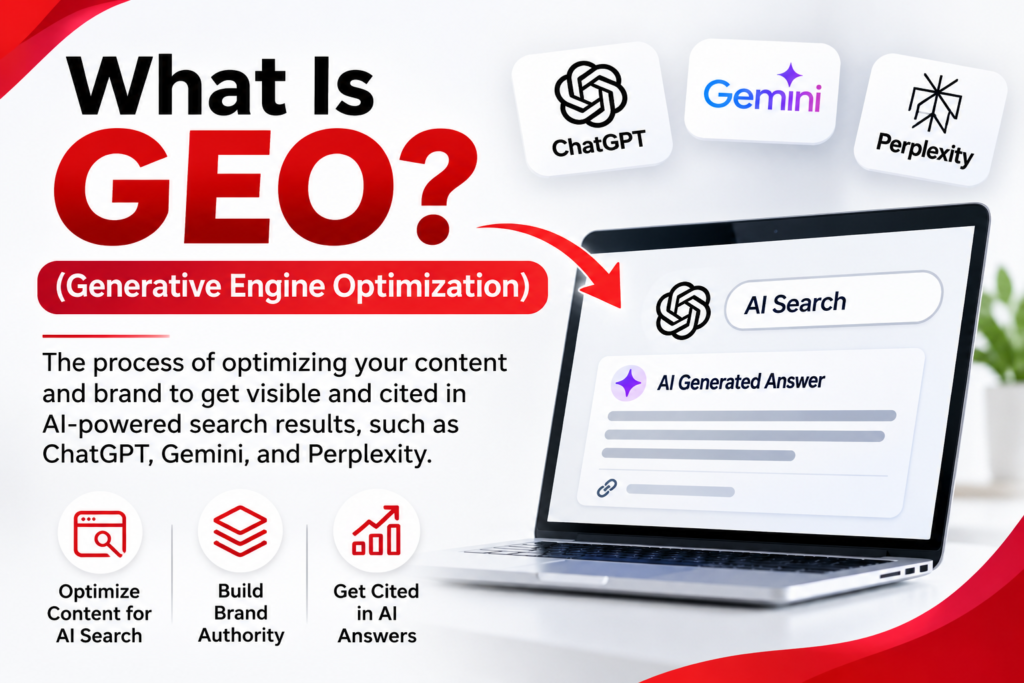
GEO stands for Generative Engine Optimization. It is the practice of improving online content so that AI-powered search and answer systems can understand it, evaluate its usefulness, and potentially reference it when generating responses.
Traditional search engines commonly present a list of webpages. Generative search experiences may combine information from multiple sources into a conversational answer, sometimes with links or citations to the original websites.
For example, imagine someone asks an AI search tool:
“What are the best ways for a beginner to improve a WordPress website’s SEO?”
The system may generate an answer covering keyword research, page speed, useful content, internal links, and technical SEO. It may also cite websites that provide relevant information.
GEO aims to make your content clear, trustworthy, relevant, and easy for these systems to interpret and potentially cite.
Important: GEO does not guarantee that an AI tool will mention your website. The selection of sources depends on the system, the query, the available information, and other factors.
Why Is GEO Important for Website Owners?
Online visibility is no longer limited to where a page appears in a traditional list of search results. AI-generated answers provide another way for people to discover information, businesses, and publishers.
Consider a technology blog that publishes tutorials about Windows errors, streaming problems, and useful AI tools. A reader might ask an AI assistant how to fix a browser problem rather than searching for an article title directly.
If the blog publishes an accurate, well-organized tutorial that addresses the problem clearly, its content may be useful to an AI-powered search experience.
GEO is worth understanding for several reasons.
- More discovery opportunities: Your content may be referenced in AI-generated answers as well as traditional search results.
- Better content organization: Writing clear explanations helps readers understand your material quickly.
- Stronger topical authority: Consistently publishing accurate, useful content can help establish your website as a relevant resource.
- More useful website visits: Readers who follow a citation may arrive with a specific question or problem to solve.
- A more adaptable SEO strategy: Combining established SEO practices with AI-search monitoring prepares you for changes in how people find information.
GEO should complement your existing SEO strategy rather than replace it.
How Does Generative Engine Optimization Work?
Generative search systems can use different methods to collect, retrieve, interpret, and summarize information. Some retrieve current web pages before producing an answer, while others may use additional sources of knowledge.
Although every platform works differently, a simplified process can help beginners understand the concept.
1. A user asks a question
The user submits a detailed question, such as, “How can I reduce unnecessary startup programs in Windows?”
This query expresses a specific need. The system attempts to identify the subject and the type of answer required.
2. The system identifies relevant information
Depending on the platform, the system may search its available index, retrieve relevant webpages, or draw on other permitted information sources.
Content that is accessible, relevant, and clearly written is easier to evaluate than a page filled with vague claims or disconnected keywords.
3. The system generates an answer
The AI system combines relevant information into a response. Some experiences provide citations or links to supporting sources, while others may present information differently.
4. The system may reference sources
A website may be cited when its content is relevant and selected as a useful source. However, a page can be indexed in a search engine without being cited in every AI-generated response.
This is why GEO requires both good foundational SEO and a content strategy focused on accuracy, clarity, usefulness, and credibility.
GEO vs. Traditional SEO: What Is the Difference?
GEO and SEO share many principles, but they emphasize different aspects of online visibility.
Area | Traditional SEO | GEO |
Main objective | Improve visibility in search results | Improve the chance of being referenced in AI-generated answers |
Content approach | Match search intent and provide useful information | Answer questions clearly and make claims easy to interpret and verify |
Technical foundation | Crawling, indexing, site structure, and performance | The same foundations, with attention to retrieval and source accessibility |
Content credibility | Demonstrate relevance, quality, and trustworthiness | Provide reliable, specific information that can support an answer |
Measurement | Rankings, clicks, impressions, and organic traffic | Citations, referenced pages, AI visibility, and referral traffic where measurable |
Expected outcome | Search visibility and potential visits | Potential inclusion in AI answers and additional discovery |
The two approaches overlap considerably. Google’s official guidance says its AI search features rely on established SEO fundamentals rather than requiring a separate set of special optimizations.
Therefore, do not abandon keyword research, technical SEO, or useful content just because AI search is growing.
7 Practical GEO Strategies for Beginners
You do not need an expensive platform or a complicated technical setup to start improving your content. Begin with the fundamentals below.
1. Answer the Main Question Early
Readers should not have to scroll through several paragraphs of general background before discovering the answer they came for.
Start important sections with a direct explanation, then provide details, examples, and limitations.
For example, a weak introduction to a troubleshooting article might spend several paragraphs discussing the history of Windows updates.
A stronger opening would explain what the error means, identify the most likely categories of causes, and introduce the first safe troubleshooting step.
This approach improves readability and makes the page’s purpose clear.
2. Use Clear Headings and Logical Structure
Organize your content around the questions a reader is likely to ask.
For a beginner’s guide to website speed, useful headings might include:
- What Is Website Speed?
- Why Does Website Speed Matter?
- How Can You Test Your Website?
- Which Changes Can Improve Loading Time?
- How Can You Measure the Results?
Use H2 headings for major sections and H3 headings for related details. Keep paragraphs focused, and use numbered steps when explaining a process.
Avoid adding headings simply to repeat keywords. Each section should contribute meaningful information.
3. Include Specific Examples and Original Insights
Generic advice is easy to find. Your article becomes more valuable when it explains how to apply that advice in a real situation.
Suppose you are writing about WordPress SEO. Instead of merely recommending image optimization, explain that a blogger can resize an oversized image, choose a suitable file format, compress it, and write descriptive alt text.
You can also add:
- Original screenshots and demonstrations.
- Examples based on your own testing.
- Comparisons that explain trade-offs.
- Common errors and their solutions.
- Lessons learned from maintaining a website.
Only describe tests or experiences that actually happened. Never invent personal experience to make an article sound authoritative.
4. Support Important Claims With Reliable Sources
AI-generated answers need useful information that can be checked. Readers also benefit when you distinguish established facts from opinions and assumptions.
When discussing technical topics, prioritize sources such as official product documentation, recognized standards organizations, and original research.
For example, an article about Google indexing should link to relevant Google Search Central documentation. A guide about Bing discovery should consult Bing Webmaster Guidelines.
When making a factual claim:
- Identify the exact claim.
- Find a source that directly supports it.
- Link to the source near the relevant explanation.
- Include dates or versions when the information can change.
- Correct or remove unsupported statements.
Citations improve transparency, but adding links alone does not guarantee AI visibility.
5. Make Your Content Easy to Understand and Verify
Use precise language instead of vague statements.
Rather than writing, “This is the best method for improving SEO,” explain what the method does, when it may help, and what limitations it has.
For technical tutorials, include the relevant software version, operating system, prerequisites, and expected result where appropriate.
For business websites, keep essential details consistent, including the business name, services, location, contact information, and opening hours.
Clear information makes your pages more useful to both people and systems that interpret web content.
6. Strengthen Your Website's Technical SEO
Even excellent content can struggle to gain visibility if search engines cannot access or index it properly.
Check the following:
- Your important pages can be crawled.
- Pages intended for search are not accidentally marked noindex.
- Your XML sitemap contains the appropriate canonical URLs.
- Internal links help visitors and crawlers discover related pages.
- Mobile layouts are usable.
- Pages load reliably and avoid unnecessary technical errors.
- Structured data, when used, accurately represents visible page content.
If you use WordPress, review your SEO plugin settings, permalink structure, sitemap, and indexing controls.
Do not install plugins or add technical markup merely because someone claims that a particular GEO trick guarantees AI citations. There is no universal GEO plugin that can guarantee inclusion in every generative search platform.
7. Monitor AI Visibility and Update Content
Publishing an article is the beginning of the process, not the end.
Periodically review whether your pages remain accurate, useful, and competitive. Update outdated screenshots, broken links, old instructions, and changed product details.
You can also test a small set of relevant questions in AI search tools and record which sources are cited. Repeat the checks over time because answers and citations may vary.
For eligible websites, Bing Webmaster Tools provides an AI Performance report that tracks citation activity across supported AI experiences. Traditional analytics can help you monitor referral traffic when visitors arrive through identifiable links.
Measure results rather than assuming that a page is successful because it has been rewritten for AI.
Common GEO Mistakes Beginners Should Avoid
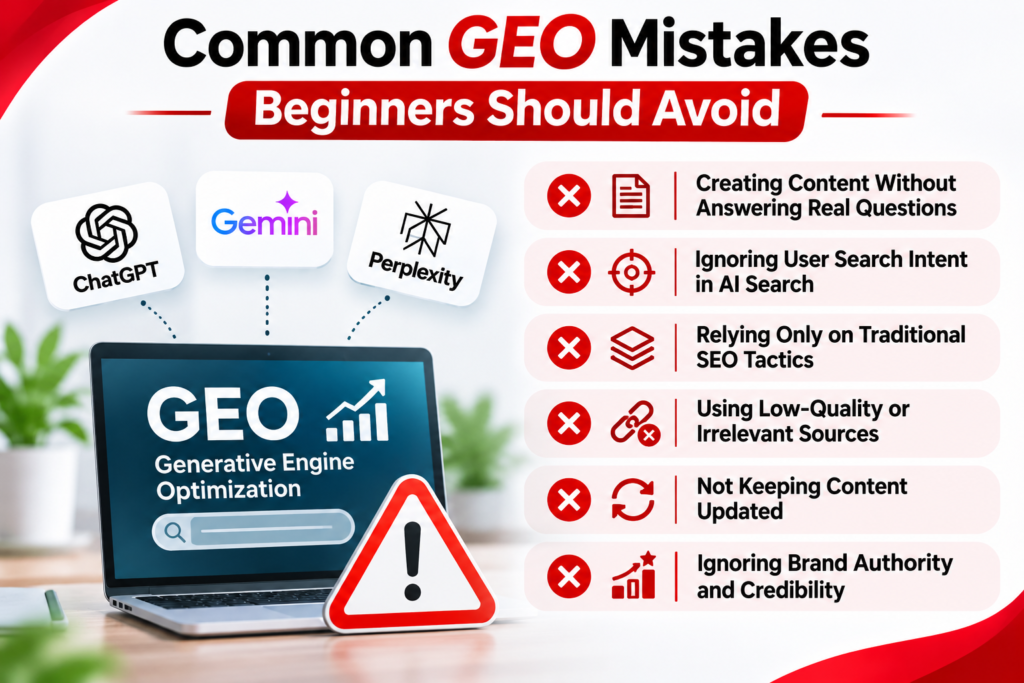
GEO is still developing, and many online recommendations make it sound more predictable than it is. Avoid these common mistakes.
Mistake 1: Treating GEO as a Replacement for SEO: AI search does not remove the need for crawlable pages, helpful content, sound technical foundations, or a good user experience. Neglecting these fundamentals can undermine your wider search strategy.
Mistake 2: Publishing Large Amounts of Generic AI Content: Using AI tools for research, outlining, or editing can be helpful. Publishing large volumes of repetitive, unverified material without adding real value is a different matter.
Review every article for factual accuracy, originality, usefulness, and clear explanations before publishing.
Mistake 3: Stuffing Content With Keywords: Repeating “GEO optimization,” “AI SEO,” or “generative engine optimization” in every paragraph makes content awkward and does not guarantee citations.
Use relevant terminology naturally and focus on answering the reader’s question.
Mistake 4: Believing Special Formatting Guarantees Citations: Tables, FAQs, bullet points, and structured data can improve usability and clarity. None is a universal shortcut to being selected as an AI source.
Choose formats that genuinely help readers understand the subject.
Mistake 5: Ignoring Measurement: A page may receive search impressions without AI citations, or it may be cited without generating many clicks. These outcomes are different.
Track traditional SEO performance and AI visibility separately where possible, then assess whether either contributes to your website’s actual goals.
A Simple 30-Day GEO Action Plan
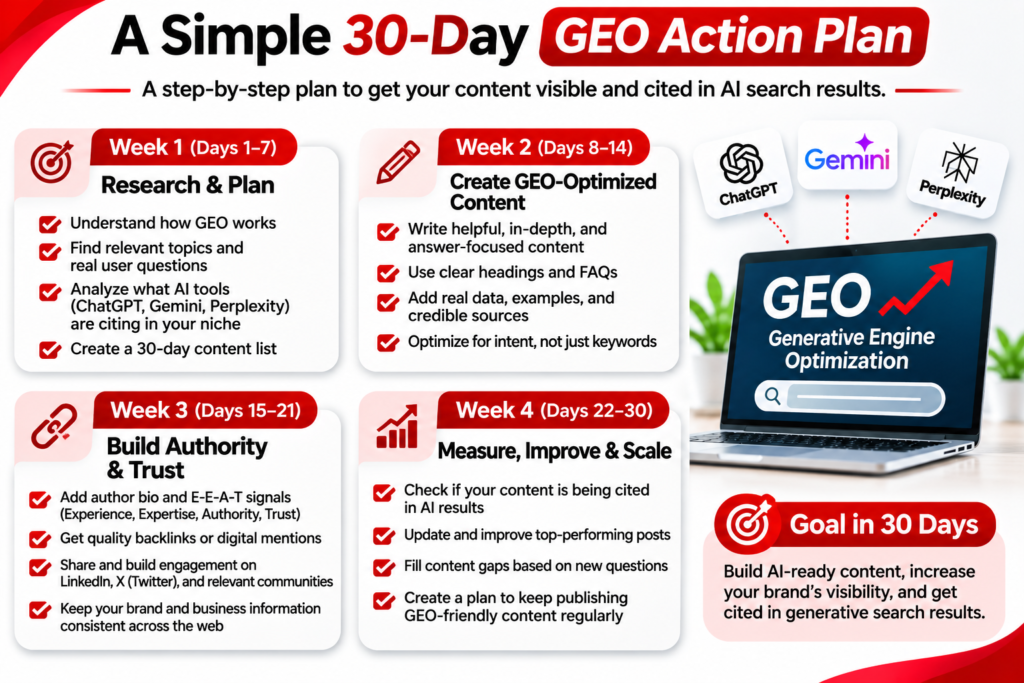
If you are new to GEO, use this practical plan to begin without overhauling your entire website.
Week 1: Audit your existing content:
- Select five important articles.
- Check their search intent, accuracy, headings, and internal links.
- Identify unanswered questions and outdated information.
Week 2: Improve content quality:
- Rewrite unclear introductions.
- Add direct answers and useful examples.
- Cite authoritative sources for important factual claims.
- Improve relevant screenshots and alt text.
Week 3: Check technical foundations:
- Review indexing and sitemap settings.
- Test important pages on mobile.
- Fix broken internal links and accidental indexing restrictions.
- Check whether your website information is consistent.
Week 4: Establish a measurement routine:
- Select a small set of questions relevant to your topics.
- Check AI-generated answers on the platforms available to you.
- Record whether your website is cited and which pages appear.
- Review search performance and referral traffic.
- Decide which improvements to test next.
This plan is a starting point, not a guaranteed path to citations. Its purpose is to build a repeatable process for improving content and evaluating results.
Key Takeaways: GEO for Beginners
- GEO means Generative Engine Optimization: improving content so AI-powered search systems can understand and potentially reference it.
- GEO and traditional SEO are closely connected.
- Clear answers, original insights, factual accuracy, and useful structure can strengthen content quality.
- Technical accessibility and indexing remain important.
- No single format, tool, keyword density, or optimization technique guarantees AI citations.
- Track AI visibility separately from rankings and website traffic whenever possible.
- Focus on helping readers first, then evaluate whether your improvements support discoverability.
Frequently Asked Questions (FAQs)
GEO, or Generative Engine Optimization, is the practice of improving content so generative search systems can interpret and potentially reference it in AI-generated answers. It involves useful content, clear structure, reliable information, and sound technical SEO. GEO does not guarantee that a particular website will appear in an AI response.
Yes, but the two overlap significantly. Traditional SEO focuses on visibility in search results, while GEO emphasizes the possibility of being referenced in generative answers. Both benefit from accessible websites, relevant content, reliable information, and a strong user experience. Most beginners should improve their SEO foundations before pursuing specialized GEO experiments.
Start by answering relevant questions clearly, organizing articles with descriptive headings, supporting factual claims with reliable sources, and adding original examples. Ensure important pages are crawlable and indexable. Monitor AI citations where possible and keep content updated. These practices can improve readiness for AI search, but selection depends on each platform.
GEO is not a separate Google ranking system that guarantees higher positions. Google states that its AI search features use established SEO fundamentals and do not require special AI-specific optimizations. Helpful, reliable, people-first content and sound technical SEO remain important. Continue measuring conventional rankings alongside any AI visibility you can observe.
Yes. Beginners can start with their existing website, free search tools, official documentation, and manual checks of AI-generated answers. Improve a few important articles, document your changes, and review results over time. Paid tools may help with larger websites or reporting, but they are not necessary to learn the fundamentals.
Conclusion: Start Building Your GEO Strategy
GEO (Generative Engine Optimization) is an evolving part of digital marketing that reflects how people increasingly discover information through AI-powered search experiences. For beginners, the most practical approach is not to chase secret optimization tricks. It is to create useful, accurate, well-structured content that answers real questions.
Start with a few important pages on your website. Improve their explanations, verify their claims, strengthen internal links, and make sure search engines can access them. Then monitor traditional search performance and AI citations where measurable.
If you are learning SEO or building a WordPress website, use uskills.pk as an opportunity to develop your knowledge of content strategy, technical SEO, and AI search optimization. Begin with one article, measure what changes, and use what you learn to improve the next one.
The goal is not simply to be mentioned by AI. It is to publish information worth discovering, trusting, and visiting.